How Long It Takes
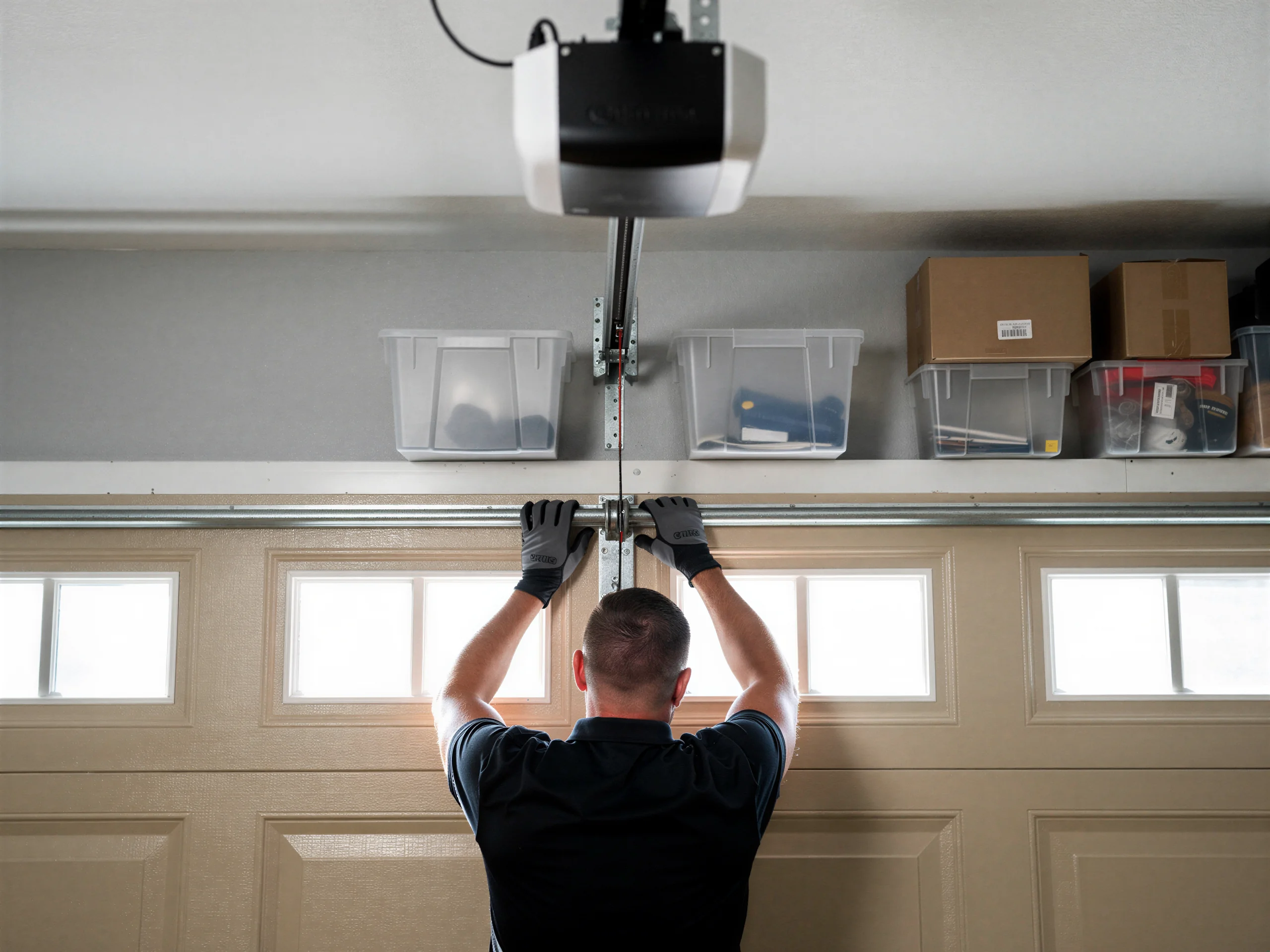
A straight opener swap in a Jarrell garage usually runs two to three hours once the crew is on site. The extra piece for this town is the drive out: we work Jarrell from our Georgetown base, about 11 miles away, so there's no local branch to dispatch from and we schedule the trip rather than fitting it in on short notice between other calls.
Because most houses here were built around 2018, almost every opener we pull is the same builder-installed chain-drive unit the production crew hung during construction. That means the swap is usually a known quantity: standard rail length, standard header bracket, no surprise framing from an older remodel. The time sink isn't the install, it's matching or upgrading whatever safety sensor and wiring setup the builder left behind, since those vary by which crew ran that phase of the subdivision.
If the existing opener's logic board or wiring is non-standard, we tell you before we start cutting anything loose, not after.
What You Pay
We don't have a flat number to quote you here, and we're not going to make one up. What drives the cost on a Jarrell job is usually the drive type you pick, the horsepower, and whether you want battery backup added, since a lot of the original builder units in this area shipped without it.
With median household income in the area around $101,653, we see a fair number of owners choosing to upgrade past the original builder-grade chain drive to a quieter belt-drive unit with battery backup rather than replacing like-for-like. That's a choice, not a requirement - the chain-drive unit works fine mechanically, it's just loud and has no backup if power drops.
One honest limitation: some builder-installed logic boards are proprietary to whatever opener brand that construction phase used, and matching a replacement board to an odd one can mean an order and a short wait rather than a same-visit fix.
What Can Go Wrong
The fault we see most in Jarrell isn't age, it's spec. With median year built around 2018, these openers aren't old - they're young enough that most are still under 10 years old.
Plastic drive gear failure
But production builders tend to hang the lightest chain-drive unit that meets code, and the first part to go on those is the plastic drive gear inside the housing. It strips under the belt-drive's normal and the opener still hums but the door stops moving.
Missing battery backup
The second common issue is missing battery backup. A lot of Jarrell garages got the base opener model with no backup battery, so a power blip takes the opener fully offline - no remote, no keypad, no wall button - until the breaker's reset or the power's back.
Bumped safety eyes
We also find the safety-eye sensors at the base of the track knocked out of alignment, usually from a bike, a trash can, or a mower clipping the bracket. It's a quick fix, but it's the single most common reason an opener reverses or refuses to close at all, and it gets misdiagnosed as a dead opener more often than it should.
Parts We Carry
For a Jarrell call we bring drive belts and chains sized to the common rail lengths used in this area's newer construction, replacement logic boards, battery backup units, wall consoles, keypads, and safety-eye sensor pairs. Most of what fails on a house built in this era is one of those parts, not the whole unit.
What we don't carry on the truck is every proprietary circuit board a given builder-era opener brand might use - if yours needs one of those, we'll tell you and get it ordered rather than guess with a part that won't fit the housing.
If what you actually need is a full opener swap rather than a part, that's the same visit, same trip from Georgetown, just a different line item.
Talk to a local pro
Garage door service in Georgetown?
Same-day service with honest, upfront quotes.